Tuesday, November 4, 2014

Apple Treat Poem, Apple Sorting activity

We continued learning our poem, Apple Treat. We jumbled the words and we arranged it by looking for clues in the actual poem (e.g., what letter does the word Apple starts with) on our chart.


Students loved putting the words correctly in the poem...


For math, we learned about sorting things based on one characteristic (e.g., colour, size). Some of the kids sorted the animals by colour or they look the same.


With apple cutouts of various sizes and colours, the children decided how to sort their apples.

Some choose to sort apples by size...


...some by colour...


Come visit our classroom and see our work on display!

Enjoy!


Tuesday, October 28, 2014

All About Me Crafts


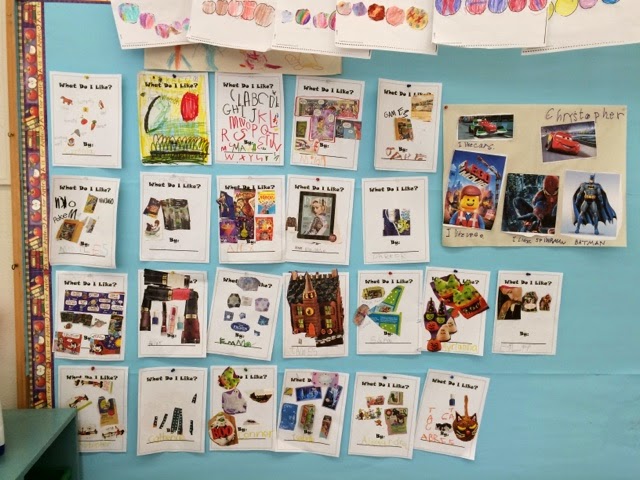
During the month of September when we were getting to know each other and establishing routines to work as a class, we learned things about ourselves. 

We made our names using macaroni, sticks, feathers, buttons to name a few.


And we cut out things from magazines, flyers and other reading materials to glue them because we like them!


Enjoy!


Wednesday, October 22, 2014

Apple Treat Poem, Ordering Apples By Size

The poem we are reading is called Apple Treat. We read the poem the first day by echoing the words we are reading on the poem. The next day, we talked about how some words rhyme, a big fancy word that describes how words sound alike.


For Math, we learned about ordering by size. Using five different apples, we talked about ordering them...


from smallest to biggest or from biggest to smallest.


The children sorted their rainbow apples...


their beautifully coloured apples...


their polka dot apples...


Some of them even had a pattern...


and others wanted to write their words...


Beautiful apples everywhere...


Enjoy!


Tuesday, October 21, 2014

IPAD Time

Due to the valuable contribution and support of our parents, the Kindergarten class will have four periods of what we call iPad Time. We have established rules about using the iPad and sharing it. We cannot be on YouTube and will use the designated apps on the iPad. The children were having a great time using the iPads. Thank you, our generous parents, for giving our school iPads. 


Monday, October 20, 2014

The Life Cycle of an Apple Tree, Apple Prints


One of the things that we would like to achieve in the science strand for kindergarten is to make our children be aware of their surroundings, the life cycles and the patterns in our world. 

In line with our field trip to the apple orchard, we read the book, The Seasons of Arnold's Apple Tree, by Gail Gibbons, where we explored the changes that the apple tree went through the different seasons. 


After discussing the changes that the apple tree went through the different seasons, we drew the pictures of the apple tree going through the changes in winter, spring, summer and fall. We talked about apple blossoms growing in the springtime, apples growing in summer, apples ripening in fall while the leaves are changing and how the tree loses its leaves (and apples as well) during winter. 


Some of the kids drew their pictures of the life cycle of the apple tree.


While others coloured the pictures of the apple tree, cut and glued them on their worksheets.


At the art centre, we made apple prints using different colours of tempra paints. See the beautiful art in our classroom!


Saturday, October 18, 2014

Borrow A Book Program

Dear Parents,

On Monday, October 21, we are going to start Borrow-A-Book Program, also called Kindergarten At-Home Reading Program. Simply put, when your child brings a book home, you have a week to read the book with him/her (some of the books are levelled books and help the child read the repetitive patterns over and over again). And accomplish the needed activity (e.g., a worksheet OR a favourite picture drawn in his/her response journal). Then, log the name of the book in the Book Log. On Friday, please make sure that you return everything (the book, the activity if applicable, the response journal, the borrow-a-book instructions and borrow-a-book log). Please find the cover letter of Borrow-A-Book Program.

-------------------------------------------------------------------------------------------------------------

Dear Parents,

Welcome to the Kindergarten At-Home Reading Program. This program is for students and parents to share reading together. It takes about 10 – 15 minutes of your time and helps your child develop skills in three major areas: print awareness, phonological awareness and oral language. These three areas most significantly impact your child's emerging literacy skills.

Each package contains a book that your; child has selected and a Borrow-A-Book Log. To begin with, students are to exchange their book every Monday for a new book to be read at home over the course of the week. Usually, the books will be simple, repetitive pattern books that will naturally invite your child to join in and read the repetitive parts. Remember to celebrate every book you read together, even if your child has just memorized the pattern. Others may choose books that you will have the pleasure to read to your child.

Your child's book will come home every Monday inside a black bag along with the Borrow-A-Book Log Sheet and a Reading Response Journal. Please keep them all together in the zip lock bag provided:
1)   Borrow-A-Book Log: Please help your child print the title of each book on the Book Log and sign it, acknowledging that you read with your child.
2)   Reading Response Journal: The directions are simple. Here are a few suggestions. Encourage your child to choose 1 particular story book she/he has read with you to draw and write about in their journal each week. Students might perhaps illustrate and write about:
·         something that happened in the book they read
·         something they particularly liked
·         something they connected with in the text (e.g. This reminds me of when I …)
·         their favourite part

Writing Response: This supports the daily writing strategies your child is acquiring on the learning continuum in the classroom and correlates to the following levels: a, (Emergent Writers), b/ c (Early Writers), d/e, (Advancing Writers)
a)     Your child draws an illustration- the parent serving as the scribe to write what is happening in your child’s    drawing.
b)     Encouraging your child to label his/her drawing by listing the dominate letter sounds (phonetic/inventive spellings) in the word he/she is trying to label (e.g., watr = water)
c)    Encouraging your child to label his/her drawing using high frequency sight vocabulary ( e.g., a car, a tree, the cat, my mom, me etc.,) 
d)    Encouraging your child to write a simple sentence using a combination of (high frequency words and phonetic spelling)
e)    Encouraging your child to make his/her writing legible for the reader via (using capitals at beginning of a sentence, leaving spaces between words, using punctuation and re-reading his/her sentences to make sure the writing looks and conveys the intended message).  
Please ensure that our Classroom Books are returned to school for exchange every Friday in your child’s large zip-lock book bag.  Our classroom books are not issued over the weekend, although your child’s book from the school library may certainly be taken home from Friday to the following Friday each week.

“Children are made readers on the laps of their parents.”  (Emilie Buchwald)   FYI: (Tips for parents on reverse side)

-------------------------------------------------------------------------------------------------------------


This is the bin of borrow-a-book bags. We will keep all the book bags here.


An example  of  borrow-a-book bag is shown above which contains a book log, borrow-a-book instructions/cover letter and a response journal all inside a ziploc bag with your child's name on it. Please ensure all materials are inside upon return. If you wish to keep the instructions at home, please do so and just let us know.


Some of the books may have activity pages. Doing the activity page will be good enough for these books.


There might be a need for crayons, glue stick and scissors, aside from using a pencil and an eraser. 

If the child opts to do a favourite picture in his/her response journal, that would be enough for these type of activity books.

If your book does not have an activity page, drawing and writing about the favourite picture would be recommended. It can be done solely by the child or it can be a combined effort between you and your child. You can help your child draw, colour and write the words. To put it simply, let it be a FUN activity for your child to look forward to. I had many response journals that were full of artistic pictures done with sticks, feathers, noodles, stickers and buttons! It looked like a beautiful treasure chest of priceless paintings!

We are looking forward to your child's wonderful journey of reading and writing!


Thursday, October 16, 2014

Classroom Book : What Do We Like by Kindergarten Rm 3

We are going to start sharing our classroom book, What Do We Like, with all our families. Each child will be given a chance to bring the book to his/her family. It is encouraged to spend a few minutes with your child reading the book. This will be a way to honour her/his writing. Ask questions about the writing. Let her/him describe the picture. 
 
Here is the cover letter for the classroom book:
-----------------------------------------------------------------------
 
October 21, 2014
 
Dear Wonderful Parents, Grandparents, Relatives, and Caregivers,

During the month of September, the children explored the theme of what we call “All About Me”. The writing activity focused on the things and people that the children liked and loved in their lives. We present to you our classroom book, What Do We Like, by Kindergarten, Room 3!
All of our children have different levels of writing and drawing. And we honour all kind of writings and drawings done by our children.  As a suggested activity for the classroom book, sit down with your child and other members of the family (e.g., a younger brother or sister) to go through the book. Listen to your child’s stories and ideas about the page that he made and the book itself. It is interesting to see how your child went through the process of drawing and writing his/her words.

Please take time to write your comments (or even your name) in the comment section and return as soon as you are through reading the book. This will allow everyone to have the chance (and fun) see the writing and drawing done by your child.
 
We look forward to hearing from you.

 
Sincerely,

Mr. Zamora                                                                  Ms. Karras
-----------------------------------------------------------------------
 
Some of the kids made a title page for the book as seen below:


We have some fine authors and illustrators in our class.

Happy Reading!